Skip to product information
1 of 5

T805

T805

Regular price $895.00 USD
Regular price Sale price $895.00 USD
Sale Sold out
Shipping calculated at checkout.

Next batch ETA: March 22-29

View full details

OVERVIEW

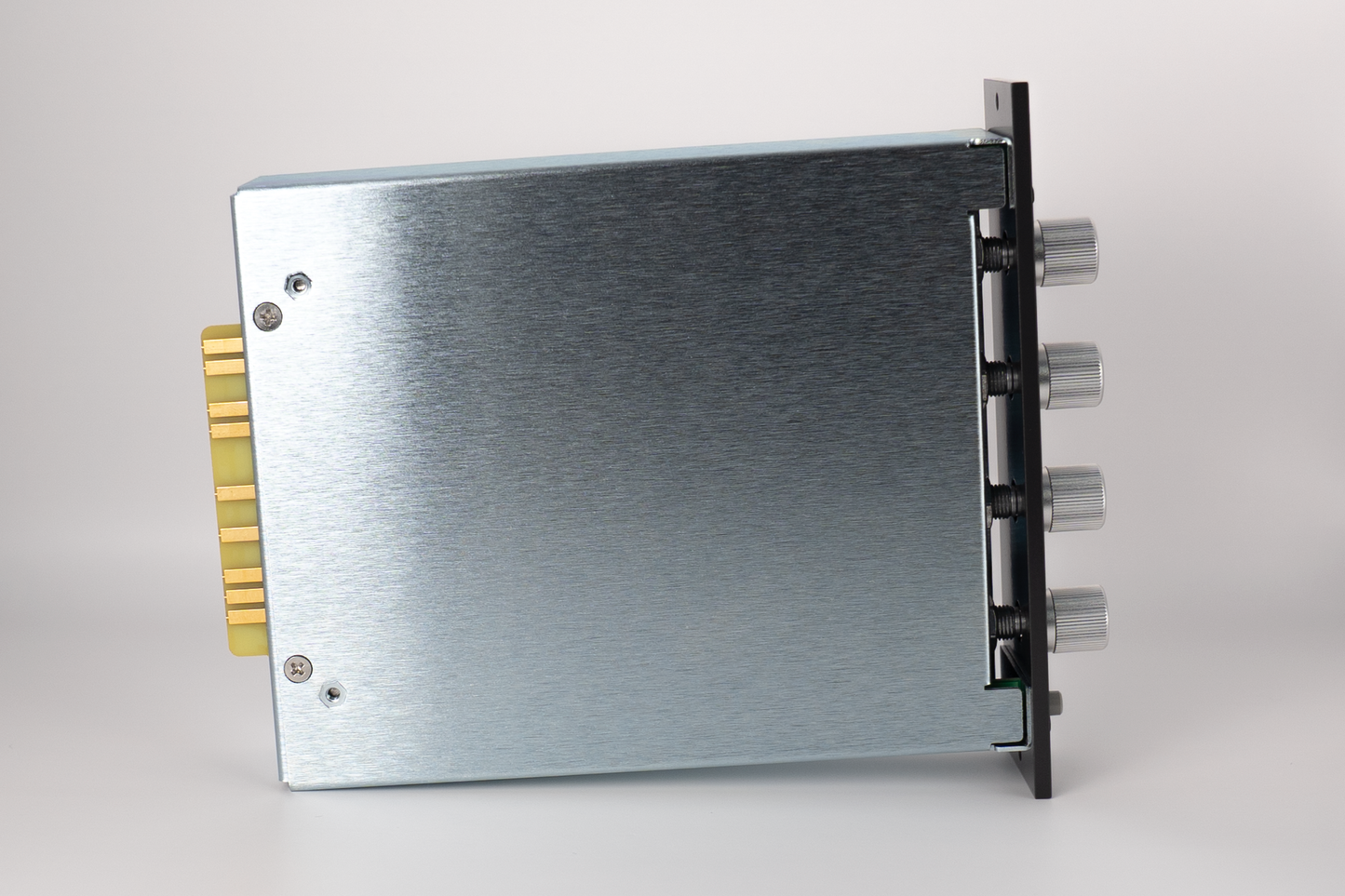
A legendary 1970s tape machine reimagined as a 500 series module.

Utilizing the discrete transistor circuitry of a Swiss tape machine to drive a Tape Element™, the T805 delivers the magnetic experience of analog tape without any of the maintenance.

Read the Full Spectrum Magnetization™ paper to learn about this revolution in audio magnetism.

FEATURES

  • Recreates the AC Bias recording process in a Tape Element
  • Creates natural high-frequency magnetic compression
  • Provides direct control over magnetic hysteresis, from subtle coloration to intense saturation
  • Recreates the Record Driver and Bias Oscillator circuitry of a 1970s Swiss tape machine
  • Includes an accurate head bump modeled on an 80s Swiss tape machine
  • Fully analog 500 series module
  • Designed, assembled, and tested in the United States

CONTROLS

GAIN

Controls the magnetic field strength in the Tape Element

  • Adjusts the input level by ±20 dB
  • Simultaneously applies ±20 dB attenuation at the output, maintaining consistent output level during adjustment

BIAS

Sets the level of the bias field in the Tape Element

  • Raising bias provides less color (overbias)
  • Lowering bias provides more color (underbias)
  • 0 dB provides the nominal calibration (maximum sensitivity)

HF

Restores high frequencies attenuated by bias

  • Provides up to 8 dB of gain at 20 kHz prior to the Tape Element
  • 4 dB provides the nominal setting when bias is set for maximum sensitivity

OUT

Increases the output level

  • Provides 16 dB of gain after the Tape Element

IN

  • ON: Engages the full T805 circuit and Tape Element
  • OFF: True analog bypass

TECHNICAL SPECIFICATIONS

Parameter Specification
Line Inputs Max Level: +26 dBu
Impedance: 24 kΩ balanced, 18 kΩ unbalanced
Line Outputs Max Level: +26 dBu
Impedance: 50 Ω
Frequency Response 20 Hz – 20 kHz, ±1.5 dB (Bias: 0, HF: 4)
Signal-to-Noise Ratio 75 dB, A-weighted
70 dB, unweighted
Bias Frequency 100 kHz
Power Consumption +16V @ 85 mA
-16V @ 75 mA

CALIBRATIONS

NOMINAL

The Nominal calibration yields maximum bias sensitivity and a balance of color and magnetic compression. This provides a tape sound commonly heard in the 50s, 60s, and early 70s.

Listen to the NOMINAL calibration applied to all individual tracks and the mix bus.
GAIN
set with the meter hovering between -12VU and -6VU.

Digital

T805 (NOMINAL)

OVERBIAS

The Overbias preset yields lower bias sensitivity with less color and less magnetic compression. This provides a tape sound commonly heard in the 70s and later.

Listen to the OVERBIAS calibration applied to all individual tracks and the mix bus.
GAIN
set with the meter hovering between -12VU and -6VU.

Digital

T805 (OVERBIAS)

USER MANUAL

FAQ

How is the T805 different than other devices?

Tape is recorded with a flat magnetic frequency response.

Other tape emulator devices do not have a flat magnetic frequency response.

A Tape Element™ magnetizes the full audio spectrum and an ultrasonic bias signal, providing a flat magnetic frequency response. This allows us to recreate the tape recording process of AC bias without moving parts.

What causes the noise floor in the T805?

The noise in the T805 is not electronic hiss or a circuit limitation. It is a natural result of recreating the AC bias magnetic recording process used in tape machines.

The effect is a magnetic phenomenon called Barkhausen noise. The 100 kHz bias signal constantly drives the magnetization inside the Tape Element back and forth. As this happens, the magnetic material does not change smoothly. It moves in many tiny discrete steps. Each microscopic step creates a small random disturbance, and when many of these occur rapidly, they combine into a broadband noise floor.

In other words, the noise floor is the sound of the Tape Element's magnetic material being excited by AC bias, the same physical process used in analog tape recording.

Why is there odd behavior when the BIAS control is set higher than +3?

As the BIAS control is increased past +3, the Tape Element and tape driving circuitry is driven beyond the normal operating range of a properly biased tape machine. Instead of improving linearity, excessive bias begins to work against the recording process.

In this region, the magnetic behavior becomes strongly nonlinear and can produce unusual compression, level shifts, and other unexpected effects. Some users may find this useful for creative sound shaping.

For standard tape machine behavior, we recommend setting BIAS between -2 and +2.